Ask three Pagans what Paganism is, and you're likely to get five different answers.
That's not necessarily a disagreement. It's a reflection of the extraordinary diversity of beliefs, practices, traditions, and relationships with the sacred that fall beneath the broad umbrella of what we call Paganism, today.
Paganism is not a single religion. It has no universal scripture, no central authority, no singular doctrine, and no requirement that its practitioners share the same understanding of divinity. Some Pagans worship many gods. Some recognize divinity in the natural world itself. Some work with ancestral spirits, others with the spirits of place, and still others understand the sacred as an immanent presence woven throughout existence. And many embrace more than one of these understandings. To begin to understand Paganism, however, we must look beyond contemporary religious labels , digging deeper than that and return to the people, landscapes, and circumstances from which these traditions emerged.
Before There Was a Word for It
The word Pagan comes from the Latin paganus, a term associated with rural inhabitants or country dwellers. Its eventual use as a religious designation developed during the Christianization of the Roman world.
The people whose traditions we now describe as Pagan did not generally call themselves Pagans. They were the peoples of their own lands and cultures: Celts, Germanic peoples, Greeks, Romans, Balts, Slavs, and countless other communities whose religious practices developed over centuries and, in some cases, millennia.
They did not all believe the same things. They did not worship the same gods or observe identical rituals. Their traditions arose from particular landscapes, climates, histories, and relationships with the world around them.
What connected many of these traditions was an understanding that human beings existed within a larger living world, one upon which their survival depended and with which they maintained relationships of obligation, reciprocity, and reverence.
When We Made the Land Home
Long before Christianity spread across Europe, human communities had developed ways of understanding and honoring the forces that shaped their lives.
For much of human history, people lived nomadically, traveling as hunters, gatherers, and foragers. They followed migrating animals, seasonal food sources, and the changing conditions of the land. Their survival required intimate knowledge of nature. With the gradual development of agriculture and the establishment of permanent settlements, that relationship acquired new dimensions.
People planted crops, tended animals, stored food, and built communities that depended upon the successful return of the growing season. The consequences of misunderstanding the natural world could be devastating. Plant too early, and frost might destroy the crop. Plant too late, and the harvest might never mature. Fail to anticipate winter, and an entire community might face starvation. The changing seasons were not simply picturesque transitions. They were matters of life and death.
People learned to recognize the signs that announced these changes. The return of migrating birds. The flowering of particular plants. The behavior of animals. The movement of the sun across the horizon. The changing length of daylight. The appearance of certain stars in the night sky. These observations became part of an accumulated body of knowledge passed from generation to generation.
The heavens themselves served as a calendar. The rising and setting of particular stars, the phases of the moon, and the sun's annual journey helped people recognize the passage of time. Across prehistoric Europe, some communities constructed monuments and ceremonial spaces aligned with significant solar events, including the solstices. Stone, sky, and landscape became instruments through which people could observe the rhythms of the year. This wisdom was a survival technology.
It is important to remember that these relationships with nature did not begin with the establishment of agricultural societies. They were already deeply embedded in the lives of earlier peoples. But settled agricultural life intensified the importance of anticipating seasonal change and gave rise to new ceremonies, obligations, and communal observances.
Over time, practical knowledge, inherited custom, and spiritual understanding became intertwined. The turning of the year was not merely observed. It was honored.
A World Alive: Animism
One of the oldest and most widespread ways human beings have understood their relationship with the world is through what we now call animism.
Animism is not necessarily the belief that everything contains a spirit, as it is sometimes simplistically described. More broadly, it is an understanding that the world is alive with beings, presences, and relationships that extend beyond humanity.
A river may be understood as a being rather than merely a resource. A mountain may possess its own presence and identity. A grove of trees may be a place of spiritual significance, because the place itself participates in the sacred. In an animistic worldview, humanity is not separate from nature, standing above it as master. We are participants within it.
The land is not simply property. Animals are not merely commodities. Water, stone, forest, and field are not necessarily understood as inert matter existing solely for human use. They are part of a world with which human beings maintain relationships. Those relationships carry responsibilities.
Respect, reciprocity, gratitude, and restraint are not simply admirable human qualities. They may be understood as essential elements of living appropriately within the world. Animism does not require belief in gods, although animistic and theistic beliefs frequently coexist. Indeed, throughout the religious history of Europe, relationships with local spirits, ancestors, sacred places, and named deities often existed side by side.
The Gods and Goddesses: Theistic Paganism
Other expressions of Pagan spirituality are explicitly theistic, recognizing one or more divine beings. Many of the pre-Christian cultures of Europe developed rich pantheons of gods and goddesses whose identities, stories, and spheres of influence reflected the experiences and concerns of the people who honored them.
Among the Greeks were Demeter, associated with agriculture and the harvest; Persephone, whose mythology became intimately connected with seasonal change; Artemis, associated with wild places and animals; and Hecate, whose complex identity encompassed crossroads, boundaries, and the unseen. The Romans honored Ceres, Vesta, Diana, Janus, and many others. Among the Norse and other Germanic peoples were Odin, Thor, Freyja, and Freyr, whose associations included wisdom, protection, fertility, prosperity, and the forces of nature. Celtic-speaking peoples honored numerous deities, including Brigid, Lugh, and the Morrígan, although their traditions varied considerably across regions and historical periods. The Baltic and Slavic peoples likewise maintained their own divine traditions, honoring deities associated with thunder, the sun, fertility, the household, and the land.
Belief in gods and goddesses may have developed within older animistic understandings of a world alive with spiritual beings and presences. These pantheons took distinct forms within particular cultures and were not interchangeable. The gods and goddesses were often understood as complex beings with personalities, relationships, histories, and powers extending well beyond any single association.
For some practitioners, the gods were and remain distinct, conscious beings worthy of worship. For others, they are manifestations of divine forces, expressions of the sacred within nature, or symbolic representations of profound truths about existence. These interpretations are not identical, and Paganism does not require that they be reconciled into one universal explanation.
It is also worth remembering that the distinction between animism and theism is not always clear. A person might honor a goddess of the land while also recognizing the land itself as a living presence. They might make offerings to ancestral spirits, acknowledge the spirit of a particular river, and participate in ceremonies dedicated to a named deity. One understanding need not exclude the others.
The Sacred Turning of the Year
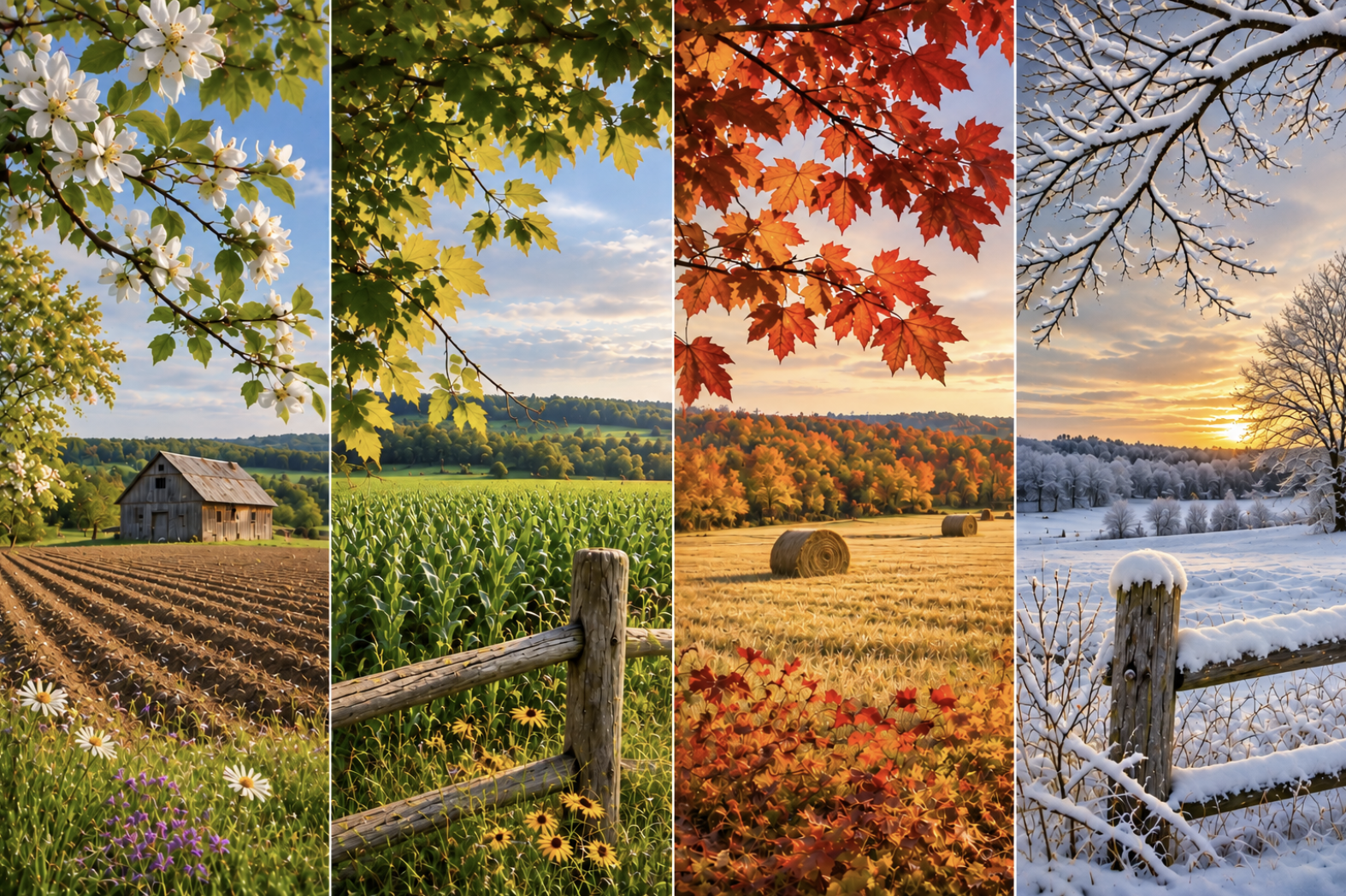
For the agricultural peoples of pre-Christian Europe, the changing seasons shaped the rhythm of human life.
Spring brought the renewal of growth, the preparation of fields, and the birth of livestock.
Summer brought long days, tending crops, and the promise of abundance.
Autumn brought harvest, preservation, and preparation for the approaching cold.
Winter brought darkness, scarcity, rest, and the necessity of surviving upon what had been gathered and stored.
These transitions were marked in different ways by different peoples.
Some traditions honored particular agricultural events. Others observed seasonal gatherings, ancestral commemorations, or ceremonies associated with the sun's changing position in the sky.
Among the Gaelic peoples, festivals such as Samhain, Imbolc, Beltane, and Lughnasadh became important markers of the year. Elsewhere in Europe, different calendars and seasonal customs developed.
There was no single, universal Pagan calendar shared by all the peoples of pre-Christian Europe. The familiar modern Wheel of the Year, with its eight festivals, is a contemporary synthesis drawing upon several historical traditions. It offers a meaningful spiritual framework for many Pagans today, but it should not be mistaken for an ancient calendar observed uniformly throughout Europe.
What these varied traditions often shared was an awareness of the cyclical nature of existence. Birth and death. Growth and decay. Light and darkness. Abundance and scarcity. Death was not an interruption of the natural order. It was part of it. The fallen leaves nourished the soil. The remains of one season contributed to the life of the next. Seeds rested in darkness before emerging into light. Human life, too, unfolded within these cycles.
The turning year offered both a practical calendar and a language through which people could contemplate the mysteries of existence.
Paganism Is Not Simply Everything That Is Not Christian
One of the difficulties in discussing Paganism is the tendency to define it by what it is not.
Historically, Christians often used the word pagan to describe people who did not belong to their religion. Over time, the label was applied broadly to an enormous variety of religious traditions.
But being neither Christian, Jewish, nor Muslim does not automatically make someone Pagan.
Hindu traditions, for example, possess their own ancient histories, philosophies, sacred literature, and religious identities. Likewise, the spiritual traditions of Indigenous peoples throughout the Americas belong to distinct nations, cultures, and communities. These traditions deserve to be understood on their own terms, rather than absorbed into a category imposed from outside.
There may be similarities between their worldviews and those found in European Pagan traditions. Reverence for ancestors, sacred relationships with the land, seasonal ceremonies, and recognition of multiple divine or spiritual beings are hardly exclusive to Europe. But similarity does not establish shared identity.
For the purposes of understanding Paganism as a religious and cultural inheritance, it is useful to begin with the pre-Christian traditions of Europe's Indigenous peoples and the contemporary spiritual movements that preserve, reconstruct, or draw inspiration from them. Even within that framework, considerable diversity remains.
Paganism Today
Contemporary Paganism includes both inherited traditions and modern religious movements. Some practitioners seek to reconstruct the religious practices of particular historical cultures through archaeology, surviving literature, folklore, and historical research. Others follow traditions transmitted through families or communities. Still others participate in modern spiritual paths that draw inspiration from older beliefs while developing new rituals, philosophies, and forms of practice.
Not every contemporary Pagan practice can be traced directly to antiquity, and not every ancient European custom survived unchanged into the present. History is rarely so accommodating.
Centuries of religious conversion, cultural transformation, migration, political upheaval, and the suppression or adaptation of older customs have left us with a complicated inheritance. Some practices survived, many through oral traditions passed down in family practices. Others were transformed. Many disappeared, leaving fragments in folklore, archaeology, place names, literature, and seasonal traditions.
Contemporary Paganism is therefore not always a simple continuation of an ancient religion. Sometimes it is preservation. Sometimes it is reconstruction. Sometimes it is revival. And sometimes it is the creation of something new, informed by an older understanding of humanity's place within the world.
Respect for the past requires that we recognize the difference between what we know historically, what we reasonably infer, and what we choose to create today.
Remembering Our Place in the World
Perhaps one of the most meaningful threads running through many expressions of Paganism is the recognition that human beings are not separate from the natural world. We belong to it. We are not “part of nature” we are nature.
Our ancestors understood that survival depended upon learning nature’s rhythms, recognizing its signs, and responding to its changes. They watched the skies because the heavens told them when the seasons were turning. They watched the animals because their movements revealed changes in the land. They observed the trees, the rivers, the weather, and the soil because these were not abstractions. They were the very conditions of life. And in many traditions, those relationships became sacred.
Today, we may no longer depend upon reading the stars to determine when to plant our fields or watching the behavior of migrating birds to anticipate the coming winter. But some of us still feel it in our bones; the relationships remain. The earth still turns. The seasons still change. The moon still waxes and wanes. Life emerges, flourishes, declines, and returns in new forms. For many Pagans, spiritual practice begins with remembering that we are participants in these cycles, not observers standing apart from them.
We may understand the sacred through the contextual lens of gods and goddesses, through the living presence of the land, through our ancestors, or through relationships that do not fit neatly into any religious category. And if you ask three Pagans to explain what all of this means, you will probably still receive five different answers. Perhaps that is as it should be.
For a spirituality rooted in the diversity of the living world, it would be rather peculiar to insist upon only one way of understanding it.